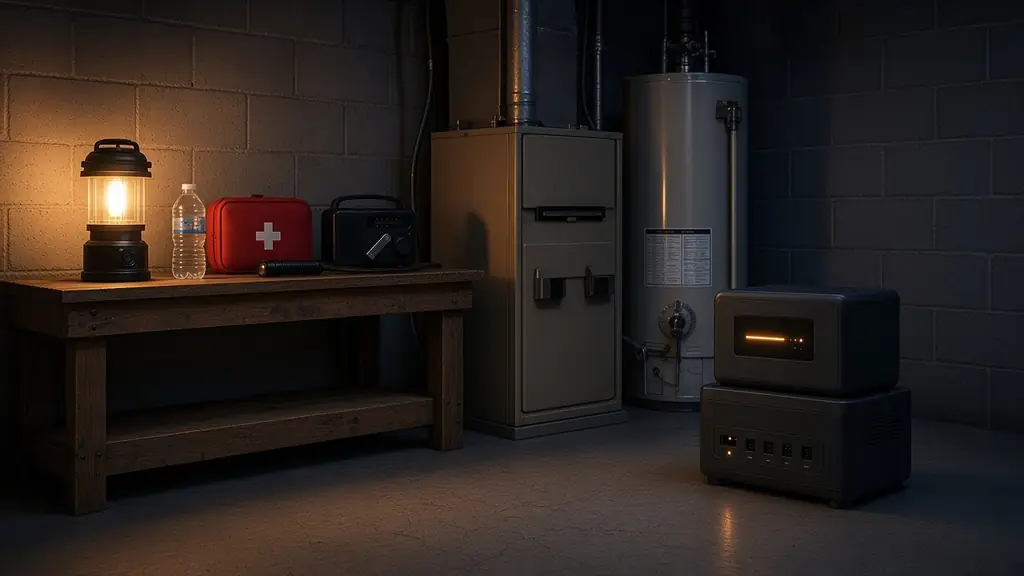
A gas furnace makes heat by burning natural gas or propane, but it will not run when the grid is down. The blower, the control board and the igniter all need electricity. With a correctly sized pure sine wave power source and a safe connection, many furnaces will keep a house warm through an outage.
Why a gas furnace needs backup power
When you set the thermostat, the furnace starts a short sequence: a draft inducer or controls come on, the burners light, and the blower pushes warm air through the ducts. That sequence is electric. Typical running draw for the blower and controls is about 300 to 800 watts, plus a short startup surge when the blower motor starts. Your furnace may sit at either end of that range, so measure it if you can. The sizing calculator can turn a measured wattage into a battery size.
How to measure the draw and size a battery or inverter
Look at the furnace nameplate, usually on the blower door. It lists volts and full-load amps (FLA). Running watts are about volts × FLA. A 120 V furnace listed at 6 A is about 720 W at full load; many blowers run lower than the nameplate once they are up to speed.
If you can, measure. A clamp meter on the hot wire at the furnace disconnect (with the door safely back in place, following the meter instructions) gives a real running current. A plug-in watt meter works only if the furnace is already on a cord-and-plug connection. Write down both the running watts and the brief spike when the blower starts. That spike is the surge your inverter has to cover.
Capacity is a separate number from output. Watt-hours ≈ running watts × hours the blower will actually run ÷ 0.85, to allow for inverter losses. The blower does not usually run every minute. If a 500 W furnace blower runs about half the time on a cold night, that is about 250 W on average, or roughly 2,350 Wh of battery for eight hours (250 × 8 ÷ 0.85). If you assume it runs continuously, size larger. Then pick a power station or inverter whose continuous output is above the running watts (with some headroom) and whose surge rating covers the startup spike.
| Example (500 W blower, 50% duty) | Battery to look for |
|---|---|
| 4 hours of heat | about 1,200 Wh |
| 8 hours of heat | about 2,350 Wh |
| 24 hours of heat | about 7,100 Wh, or a way to recharge |
These examples are starting points, not a rating for your furnace. Use your measured watts and a realistic run time. For outages longer than a day, plan how you will recharge: solar, or a portable generator outdoors.
Use a pure sine wave inverter
The furnace control board and many blower motors, especially ECM (electronically commutated) motors, expect a smooth AC waveform. A pure sine wave power station or inverter is required. A modified sine wave inverter can make the motor hum, run hot or fail, and can damage electronic controls. If the product does not clearly say "pure sine wave," do not use it on a furnace.
Connect it safely
Most furnaces are hard-wired. The safe ways to feed them from a backup source are a furnace or generator transfer switch, or a power inlet with an interlock, installed by a licensed electrician. That keeps the backup source isolated from the utility so you cannot backfeed the grid, which can kill lineworkers and is illegal.
Never cut the furnace cord to splice on a plug unless an electrician wires a code-compliant cord-and-plug connection, where local code allows it. Do not plug a generator or power station into a wall outlet. Do not run extension cords through a jammed-open blower door as a standing setup; if an electrician installs a listed cord-and-plug connection, use a heavy cord sized for the load and keep the furnace door secured as the installer designed it.
Never cut the furnace cord to splice on a plug unless an electrician wires a code-compliant cord-and-plug connection, where local code allows it.From this guide
The car-battery-and-inverter idea
People sometimes try to run a furnace from a car battery and a plug-in inverter. Be honest about the limits. A typical automotive battery stores on the order of 500 to 700 watt-hours in total; you should not drain it flat if you still need to start the car. After inverter losses, a 500 W furnace blower can empty that battery in well under an hour. A small 300 W car inverter cannot run most furnace blowers at all.
If the battery gets low and you start the car to recharge it in a garage, a carport or even just outside an open garage door, the exhaust can fill the house with carbon monoxide. That can be fatal. Do not run a vehicle, or a generator, in or near a garage to keep a furnace going.
Generators, carbon monoxide and venting
- Portable generators belong outdoors only, at least 20 feet from the house, with the exhaust pointed away from windows, doors and vents. The U.S. Consumer Product Safety Commission is clear: a generator in a garage, basement, or on a porch is too close, even with the door open.
- Install battery-powered carbon monoxide alarms, or alarms with battery backup, on every level and outside sleeping areas. Test them.
- A gas furnace needs a clear intake and a clear exhaust. Keep snow, leaves and debris off the flue and any sidewall vent. Do not block combustion-air openings. Never use a gas oven, range or grill as a heater; those appliances are not vented for that use and can produce carbon monoxide.
For a wider comparison of batteries and generators, see generator vs portable power station. For a full outage list, see the prep checklist.
Example products for a furnace backup
Pure sine power stations sized for a blower
- Jackery Explorer 1000 v2 portable power station1,024 Wh LiFePO4; 1,500 W AC output (3,000 W surge)
- Anker SOLIX C1000 Gen 2 portable power station1,024 Wh; 2,000 W output (3,000 W peak)
- EcoFlow DELTA 2 Max portable power station2,048 Wh LFP; 2,400 W output; expandable to 6 kWh
- EcoFlow DELTA 3 Ultra portable power station3,072 Wh; 3,600 W AC output (7,200 W surge)
Transfer switch and inlet (installed by an electrician)
- Reliance Controls 31410CRK 10-circuit 30 A generator transfer switch kit10-circuit, 30 A manual transfer switch kit for generators up to 7,500 running watts; 18-inch conduit whip
- Reliance Controls PB30 30 A power inlet box30 A NEMA 3R outdoor power inlet for generators up to 7,500 running watts
Carbon monoxide alarm
- Kidde battery-powered carbon monoxide alarmAA battery powered, so it works when the power is out
Specs come from each product's Amazon listing (checked Nov 27, 2026). We don't list prices, so check the current price, stock and compatibility on Amazon. These are examples that fit the size, not the only good choices.
Published by Good Vision Media. Updated November 27, 2026. General information only; for anything wired into your home, use a licensed electrician.