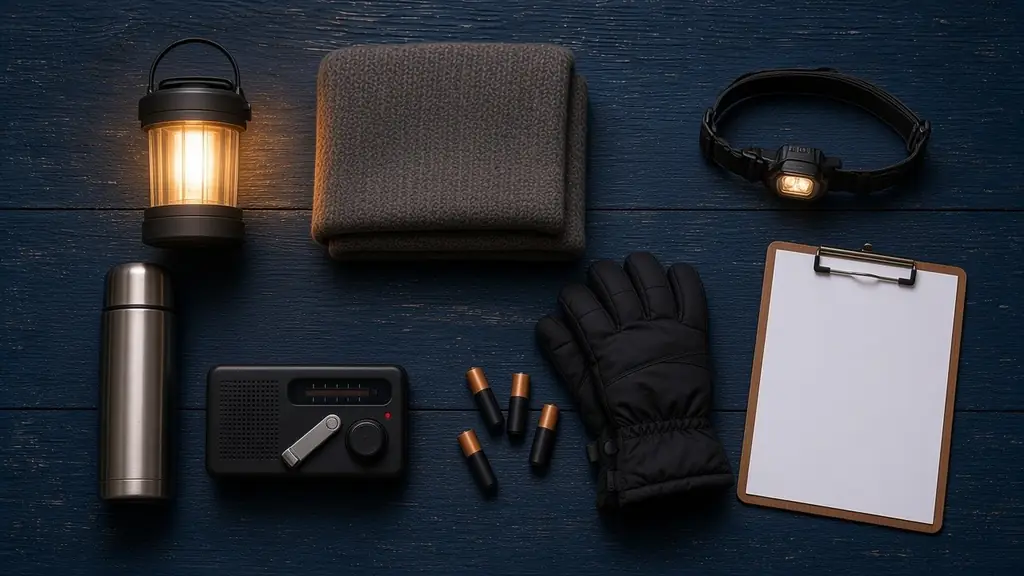
A one-page checklist for the hours before a winter storm, the first hour after the power goes out, and the days after. Print it, tape it inside a cabinet, and tick items off. Every item here is explained, with sources, in our winter outage preparation guide.
Write these down now
- Utility outage phone number: ______________________________
- Gas utility emergency number: ______________________________
- Main water shutoff is located: ______________________________
- Nearest warming center or friend's house: ______________________________
- Doctor or pharmacy (medications and medical devices): ______________________________
- Poison Control (carbon monoxide): 1-800-222-1222
When a winter storm watch or warning is issued
- Charge phones, power banks, power stations, lanterns and headlamps.
- Put fresh batteries in the radio, flashlights and carbon monoxide alarms. Test every alarm.
- Fill the car's gas tank. Check the winter kit in the car: blankets, flashlight, water, snacks, jumper cables, sand.
- Bring in or cover what the weather can ruin. Disconnect outdoor hoses. Cover outdoor faucets.
- Locate and test the main water shutoff.
- Fill a few water containers for drinking and washing, and set aside food that needs no cooking.
- Check the fridge and freezer thermometer. Put a thermometer in both if you do not have one.
- Pick the one room you will live in and move blankets, sleeping bags and warm clothes there.
- Refill prescriptions. Plan for refrigerated medication and any powered medical device.
- Fuel for generator or heater stored outside the living space. Never inside the house.
- Tell a relative or neighbor your plan. Plan to check on older neighbors.
When the power goes out
- Report the outage to your utility, even if you think a neighbor already did.
- Switch to battery light. No candles if you can avoid it.
- Close the doors of the room you chose. Put on layers: hat, scarf, dry socks, loose layers.
- Keep the refrigerator and freezer closed.
- Turn on a weather radio for alerts and restoration updates.
- Open the cabinet doors under kitchen and bathroom sinks that are on exterior walls.
- Let a cold faucet drip slowly, on a faucet served by exposed pipes.
- Unplug sensitive electronics. Leave one light switched on so you know when power returns.
- If you have a generator: move it outdoors, at least 20 feet from doors, windows and vents, with the exhaust pointed away from the house. Run a long extension cord to it.
- Check that every carbon monoxide alarm is working and on every level and near the bedrooms.
Every few hours
- Check the indoor temperature and the people in the room. Look for shivering, confusion, drowsiness or slurred speech. A body temperature below 95°F is a medical emergency.
- Check babies and older adults first. Babies should never sleep in a cold room.
- Check the fridge and freezer thermometer. Food at 40°F or higher for two hours or more should be thrown away.
- Check pipes: any faucet that only trickles may be frozen. Keep it open.
- Clear snow from furnace, dryer and appliance vents and from the generator's area.
- Recharge phones and radio from a bank or station. Use battery power sparingly.
- If your home is too cold to stay, go to a warming center or a friend's home.
Never do these
- Never heat with a gas oven, gas range, grill, camp stove or lantern indoors.
- Never run a generator indoors, in a garage, basement, shed, porch or carport.
- Never leave a space heater unattended or use it on a power strip. Keep 3 feet of clear space around it.
- Never leave a lit candle unattended.
- Never use a torch to thaw a pipe.
- Never plug a generator into a wall outlet.
Never heat with a gas oven, gas range, grill, camp stove or lantern indoors.From this guide
After the power comes back
- Raise the thermostat slowly. Look for dripping pipes and wet walls. Shut the main valve if a pipe has burst.
- Throw out food that was above 40°F for two hours or more. When in doubt, throw it out. Discard refrigerated medicine if the power was out more than a day, unless the label says otherwise.
- Plug electronics back in one at a time.
- Recharge batteries and refill fuel. Restock what you used.
- Write down what you missed. Add it to the sizing calculator.
Sources
- Ready.gov: Winter Weather, Power Outages. CDC: winter storm safety, hypothermia, power outages.
- CPSC: winter weather safety tips. U.S. Fire Administration: heating fire safety. EPA: winter weather and indoor air quality. Red Cross: frozen pipes.
Gear on the checklist
Check the current price and seller on Amazon before you buy. We don't list prices.
Light, radio and alarms
- Coleman Classic Rechargeable LED LanternUp to 800 lumens; built-in rechargeable battery with USB charging port
- Energizer LED Headlamp PRO, 2-pack260 lumens, up to 80 m beam, dimmable, IPX4 water resistant; runs on AAA batteries
- Midland WR120B NOAA weather radioNOAA weather alerts with SAME; battery backup
- Kidde battery-powered carbon monoxide alarmAA battery powered, so it works when the power is out
Warmth, food safety and pipes
- EverOne 80% wool fire-retardant blanket, 66 x 90 in80% wool, fire retardant, 66 x 90 in
- Rubbermaid Commercial fridge/freezer thermometerReads 20 to 80 °F (-30 to 30 °C); stainless steel case
- Frost King 6 ft foam pipe insulation (1/2 in ID)1/2 in inner diameter, 1/2 in wall, 6 ft long; closed-cell foam tube; check your pipe size before buying
- Frost King FC1 outdoor foam faucet cover, 4-packFoam cover for outdoor faucets (freeze, wind and chill protection); pack of 4
Specs come from each product's Amazon listing (checked Nov 27, 2026). We don't list prices, so check the current price, stock and compatibility on Amazon. These are examples that fit the size, not the only good choices.
Published by Good Vision Media. Updated November 28, 2026. General information only; for anything wired into your home, use a licensed electrician.