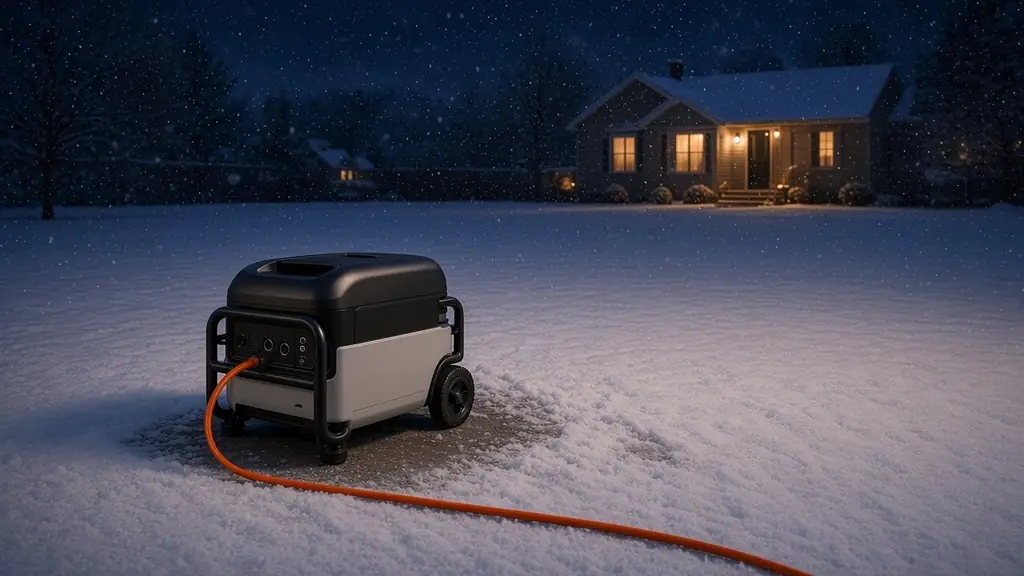
Winter outages are when carbon monoxide (CO) poisonings happen. People run a generator in the garage to keep the furnace on, bring a grill indoors to stay warm, or leave a car running in a closed garage. The gas has no smell or color. This guide covers where a generator can go, what to do about snow and wet ground, how to place alarms, the symptoms, and the winter-specific traps. It complements generator vs portable power station and the gas furnace guide, which both touch on safety briefly.
How big the risk is
The U.S. Consumer Product Safety Commission (CPSC) says an average of nearly 100 people die in the U.S. each year from CO poisoning caused by portable generators. CPSC also says generator CO poisoning can happen so quickly that people may become unconscious before they recognize the nausea, dizziness or weakness. The CDC says that when outages happen during emergencies such as hurricanes or winter storms, using other sources of fuel or electricity for heat, cooling or cooking can let CO build up in a home, garage or camper.
The CDC lists common sources: gas-powered generators, charcoal grills, propane stoves and charcoal briquettes used indoors for cooking or heating, motor vehicles, fire, and gas-powered tools such as pressure washers. Babies, pregnant women, older adults and people with chronic heart disease, anemia or respiratory illness are at higher risk.
Where a generator can go
- Outdoors only, at least 20 feet from the house. CPSC and the CDC agree on 20 feet, and Ready.gov adds that this means 20 feet from windows, doors and attached garages. Point the exhaust away from the house and from neighbors' windows.
- Not on a porch or in a carport. CPSC says it is too close to the home, and says to never operate a generator in a home, garage, basement, crawlspace or shed, because opening doors or windows will not provide enough ventilation.
- Use a long extension cord. The CDC suggests a cord longer than 20 feet to keep the generator at a safe distance, with each appliance on its own heavy-duty outdoor-rated cord.
- Seal off nearby vents. CPSC says to close windows and seal off vent openings near the generator or in the path of its exhaust.
- Keep the fuel outside. The CDC says not to store gasoline indoors where fumes could ignite. Ready.gov says to let the generator cool before refueling, because fuel spilled on hot engine parts can ignite.
Snow, rain and wet ground
A generator in the open is exposed to the weather, and wet equipment is a shock risk. The CDC says generators should sit in a space where rain and snow will not reach them, and that you should not use a generator or appliances if they are wet. Ready.gov says to keep the generator dry and protected from rain or flooding, because touching a wet generator or devices connected to one can cause electric shock.
CPSC says to follow the manufacturer's instructions about electrical shock in bad weather. Those instructions may include using an NFPA-rated noncombustible generator tent, or waiting for the rain or snow to pass. The key point is that you cannot move the generator into a garage or against the house to get it out of the snow. Keep the 20 feet and shield it, or turn it off.
Snow also blocks exhaust. CPSC says to clear snow away from outside vents for fuel-burning appliances such as furnaces so that dangerous CO does not build up in the house, and the CDC says to keep vents and flues free of debris. After a heavy snowfall, check the furnace and water heater exhaust, the dryer vent and any chimney.
Choose a generator with CO shutoff
CPSC advises looking for a portable generator with a CO shut-off feature, which turns the engine off when dangerous CO builds up nearby. CPSC says models certified to the latest PGMA G300-2023 and UL 2201-2023 standards include CO safety technology meant to significantly reduce the risk, and that UL 2201 models also have reduced CO emissions. Check the listing for the standard before you buy. Among the generators on our other pages, the Honda EU2200i lists a CO-MINDER shutoff, the WEN DF360iX lists a CO shutdown sensor and the Champion 4500 lists CO Shield auto shutoff, according to their Amazon listings. That is not the same as certification, and none of it makes indoor use safe.
CO alarms
Carbon monoxide is colorless and odorless, and people who are asleep can die before they notice any symptoms. An alarm is the only warning you will get.
- Where: CPSC says to install battery-operated alarms or alarms with battery backup on every level of the home and outside each separate sleeping area. Interconnected alarms are best: when one sounds, they all sound.
- Power: in an outage a plug-in alarm without a battery will not work. Use battery-powered or battery-backup ones (our gift guide lists a battery-powered example).
- Test monthly and replace batteries as needed (CPSC). Never ignore an alarm: get outside immediately, then call 911.
- Smoke alarms too. Heating season is also fire season. CPSC says to have smoke alarms on every level and inside each bedroom.
- Annual service. CPSC says to have heating systems, chimneys and vents inspected and serviced yearly by a trained technician. Open the fireplace damper before lighting a fire and keep it open until the ashes are cool.
Carbon monoxide is colorless and odorless, and people who are asleep can die before they notice any symptoms.From this guide
Symptoms and what to do
| Level | Symptoms (CPSC and CDC) |
|---|---|
| Low to moderate | Headache, fatigue, shortness of breath, nausea, dizziness. These look like the flu but without a fever. |
| High | Mental confusion, vomiting, loss of muscle coordination, loss of consciousness, and death |
The CDC lists the most common symptoms as headache, dizziness, weakness, nausea, vomiting, chest pain and confusion, and says people who are sleeping or who have been drinking alcohol can die before ever having symptoms. If anyone shows signs, the CDC says to call 911 or Poison Control at 1-800-222-1222 or consult a health care professional right away. Get everyone, including pets, out into fresh air first. Several people, or a pet, feeling ill at the same time with no fever is a clue.
Other winter CO traps
| Source | What the official sources say |
|---|---|
| Gas oven or range | Never use it to heat a home (CDC, Ready.gov). It also raises the risk of fires and burns. |
| Charcoal or gas grill, hibachi, camp stove, lantern | Never use indoors, in a tent or camper, even with ventilation (CDC, CPSC). Use at least 20 feet from windows (Ready.gov). |
| Vehicle in a garage | Never leave the motor running in a garage or other enclosed or partly enclosed space (CDC). |
| Vehicle when stranded | The CDC says to run the motor and heater about 10 minutes an hour, open one window slightly, and make sure snow is not blocking the exhaust pipe. |
| Unvented fuel heaters (kerosene, propane) | Can cause CO poisoning if not used properly. Look for the ANSI Z21.11.2 label and have a CO detector (Department of Energy). Check local rules for kerosene. |
| Fireplace, wood stove, furnace | Keep vents and flues clear and have them serviced yearly (CPSC, CDC). |
The no-exhaust alternative
A power station, a battery bank or a home battery makes no exhaust, so it adds no CO. That is the main safety argument for batteries for small loads (phones, router, lights, a furnace blower). It does not help with resistance heat: see sizing backup power for winter heating. If you do own a generator, never connect it by plugging into a wall outlet; use a transfer switch or inlet installed by a licensed electrician. For what to do before the storm, see how to prepare for a winter power outage, and for a printable version, the winter storm outage checklist.
- CPSC: Winter weather safety tips (March 16, 2026); generator, CO and fire hazards (May 27, 2026); Generators and engine-driven tools; Protect your family from carbon monoxide poisoning.
- CDC: What to do to protect yourself during a power outage; Safety guidelines during and after a winter storm; Clinical guidance for carbon monoxide poisoning following disasters and severe weather.
- Ready.gov (FEMA): Winter Weather, Power Outages. Department of Energy: home heating systems guide (PDF, 2013).
Alarms, generators and cords
A CO shutoff feature lowers the risk but never makes indoor use safe.
Battery-powered CO alarm
- Kidde battery-powered carbon monoxide alarmAA battery powered, so it works when the power is out
Inverter generators with a CO shutoff feature listed
- Honda EU2200i inverter generator2,200 W inverter, gasoline; CO-MINDER carbon monoxide shutoff
- WEN DF360iX dual-fuel inverter generatorGasoline 2,900 rated / 3,600 surge W; propane 2,600 / 3,500 W; CO shutdown sensor
- Champion 4500-watt dual-fuel inverter generator3,500 running / 4,500 starting W on gasoline; propane capable; CO Shield auto shutoff
Long outdoor cord, so the generator stays far away
- Southwire 50 ft 12-gauge outdoor extension cord50 ft, 12/3 SJTW outdoor cord
No exhaust: power stations
- EcoFlow RIVER 3 (230 Wh) portable power station230 Wh LFP battery; about 1-hour AC recharge
- Jackery Explorer 1000 v2 portable power station1,024 Wh LiFePO4; 1,500 W AC output (3,000 W surge)
- Anker SOLIX C1000 Gen 2 portable power station1,024 Wh; 2,000 W output (3,000 W peak)
Specs come from each product's Amazon listing (checked Nov 27, 2026). We don't list prices, so check the current price, stock and compatibility on Amazon. These are examples that fit the size, not the only good choices.
Published by Good Vision Media. Updated November 28, 2026. General information only; for anything wired into your home, use a licensed electrician.