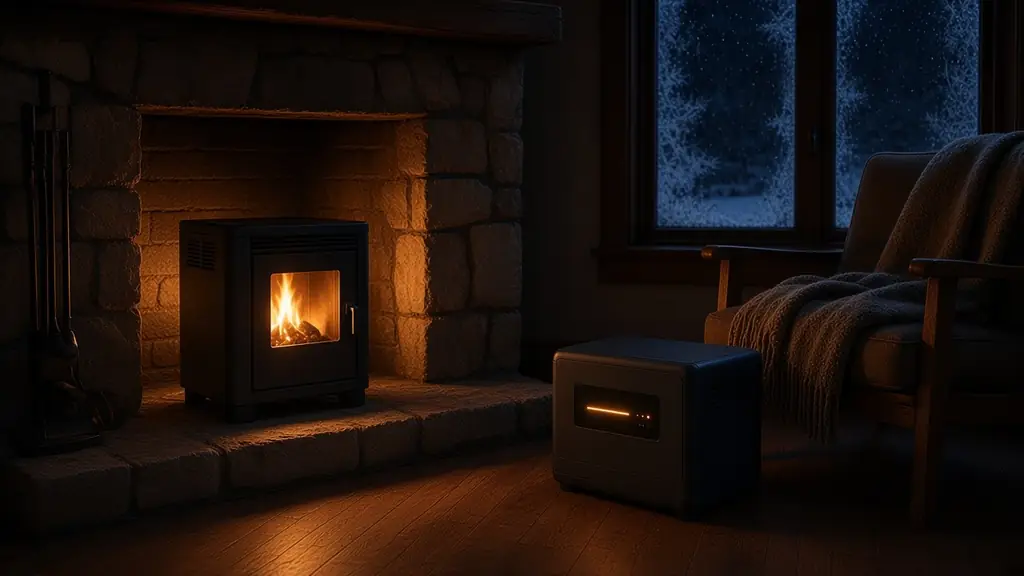
Winter heating loads fall into two groups. Heat that comes from burning something (gas, oil, pellets, wood) needs only a little electricity for fans, pumps and controls. Heat made from electricity needs a lot. The first group is easy to back up with a battery. The second drains one fast, and that is why a power station that runs a router for days gives you only minutes of space heater.
This guide gives real numbers from manufacturers' spec sheets and manuals, and worked watt and watt-hour math you can copy. For the gas furnace itself, including how to connect it safely, read how to run a gas furnace during a power outage. For a general method see how to size a portable power station, and for what to do before and during the storm see how to prepare for a winter power outage.
The four numbers you need
- Running watts (W): what the device draws once it is running. It is on the nameplate or spec sheet, or you can multiply volts by amps.
- Starting (surge) watts: motors draw more for a moment when they start. A power station's or generator's surge rating has to cover this.
- Duty cycle: the share of the time the device is actually running. A furnace blower or a pump cycles on and off. A heater at full output does not.
- Watt-hours (Wh): the energy over time. Wh = running watts × hours × duty cycle ÷ 0.85. The 0.85 allows for the inverter's losses, the same factor our sizing calculator uses.
Capacity and output are separate limits. A station with 1,024 Wh and a 1,500 W output can run a 1,500 W load, but only for a short time. A plug-in watt meter, such as a Kill A Watt, shows the real watts of anything with a standard plug.
What each heating load draws
| Load | Running draw | Notes | Source |
|---|---|---|---|
| Gas furnace blower and controls | about 300 to 800 W | Measure it. Needs a pure sine source and a safe connection. | Our furnace guide; furnace nameplate |
| Boiler circulator pump (Grundfos UPS 15-58 FC example) | 60 W, 80 W or 87 W (speed 1, 2, 3) | 115 V, 0.55 to 0.75 A. Add the boiler's own controls and burner from its nameplate. | Grundfos specification sheet |
| Pellet stove (US Stove AP60 example) | 180 W; 350 W while the igniter runs | Label: 120 V, 3.0 A. The igniter runs only at startup. | Manufacturer owner's manual |
| Plug-in electric space heater (Lasko 1,500 W example) | 1,500 W | 12.5 A at 120 V, which is most of a 15 A circuit. | Manufacturer spec sheet |
| Self-regulating pipe heat cable | 3, 5, 8, 10 or 12 W per foot | Rated at 50°F. Draws more at a colder start. | Manufacturer data sheet (SLCBL series) |
| Submersible well pump, 1/2, 3/4 or 1 hp | see below | Minimum generator size 2, 3 or 4 kW (50% more for 2-wire motors). | Franklin Electric AIM Manual, Table 3 |
These are example products. Your furnace, stove or pump will differ, so use its nameplate, manual or a watt meter. The point is the scale: a pump is under 100 W, a pellet stove is about 200 W, and a space heater is 1,500 W.
Heat from electricity: why a space heater drains a power station
An electric resistance heater turns electricity into heat directly. The U.S. Department of Energy lists electric resistance heating at 95 to 100 percent efficient, which sounds good, but it means every watt-hour you put in is a watt-hour of heat and no more. One kilowatt-hour makes about 3,412 Btu, so a 1,500 W heater at full output makes about 5,118 Btu an hour (1,500 × 3.412). That takes 1,500 watt-hours of battery every hour.
Example, running one heater at full output on three different stations, with 15% inverter losses:
| Station | Battery | Runtime at 1,500 W | Math |
|---|---|---|---|
| Jackery Explorer 1000 v2 | 1,024 Wh | about 35 minutes | 1,024 × 0.85 ÷ 1,500 = 0.58 h |
| EcoFlow DELTA 3 Ultra | 3,072 Wh | about 1 h 44 min | 3,072 × 0.85 ÷ 1,500 = 1.74 h |
| Anker SOLIX S5000 | 5,024 Wh | about 2 h 51 min | 5,024 × 0.85 ÷ 1,500 = 2.85 h |
To heat one room for a 12-hour night at 1,500 W you would need about 18,000 Wh of energy, or about 21,200 Wh of battery after losses. Few portable stations hold a fraction of that. That is why the better plan is:
- Use a burning heat source for heat (a gas or oil furnace, a pellet stove, a wood stove) and let the battery run only its fans and pumps.
- Or use a generator for resistance heat: a 1,500 W heater needs a generator with at least that running output with room to spare, plus fuel for the hours you run it. See generator safety in winter.
- If you must use a plug-in heater on a station, treat it as a way to take the chill off for an hour, not as your heat plan. Plug it directly into the station's own outlet, not into an extension cord or power strip. The U.S. Fire Administration and the CPSC both say never to power a space heater that way, and CPSC adds that portable electric heaters are high-wattage appliances and cause roughly 1,200 fires a year (2008 to 2010 estimate).
Unvented fuel-burning portable heaters (propane, kerosene) avoid the electric problem and bring a worse one. The Department of Energy says unvented combustion heaters can cause carbon monoxide poisoning if not used properly, should carry the ANSI Z21.11.2 compliance label, and that every home with a space heater should have a carbon monoxide detector. The CDC says to check that kerosene heaters are legal in your area.
Worked examples
Heat made from electricity is the one thing a battery can't keep up with. These examples show the contrast for a 12-hour night, using the spec-sheet watts above.
| Load (12-hour night) | Assumption | Energy | Battery needed |
|---|---|---|---|
| Boiler circulator pump | 87 W (speed 3), running half the time | 87 × 12 × 0.5 = 522 Wh | about 614 Wh |
| Pellet stove | 180 W running all night, plus one 10-minute ignition at 350 W (58 Wh) | 2,160 + 58 = 2,218 Wh | about 2,610 Wh |
| Gas furnace blower | 500 W, running half the time | 500 × 12 × 0.5 = 3,000 Wh | about 3,530 Wh |
| Heat cable on 30 ft of pipe | 5 W per foot nominal = 150 W, on all night | 150 × 12 = 1,800 Wh | about 2,120 Wh |
| Electric space heater | 1,500 W at full output | 18,000 Wh | about 21,180 Wh |
Notes on the numbers:
- Pellet stove. The 180 W is the manual's operating figure. On a low setting the stove usually draws less, so the real number may be lower. Measure it.
- Boiler. The pump is only part of a hydronic system. The boiler's control board, gas valve and ignition draw power too, so add the boiler's nameplate amps × 120 V.
- Heat cable. The 5 W per foot is the rating at 50°F. The maker's chart allows shorter maximum runs on the same breaker when the cable starts cold, which means more current at a cold start: for the 120 V, 5 W/ft cable on a 15 A breaker the limit is 249 ft at a 50°F start, 215 ft at 32°F and 170 ft at -4°F. A freezing pipe therefore pulls more than the nominal 150 W at first. Follow the maker's chart for maximum circuit length.
- Furnace. The 500 W blower is the midpoint of our furnace guide's range. Your furnace may be higher or lower.
Heat made from electricity is the one thing a battery can't keep up with.From this guide
Sizing by situation
- Boiler pump and essentials (about 1,000 Wh and up). The pump plus a router, phones and lights fits a 1,000 Wh class station for a night, with room to recharge.
- Pellet stove (about 2,000 to 3,000 Wh). Plan on 2,000 Wh and up for a night. Check the stove's manual for any power-source requirement. A pure sine wave source is the safe choice for electronic controls.
- Gas furnace (about 3,000 Wh for 12 hours). See the furnace guide for pure sine wave and connection requirements.
- Resistance heat, a well pump, or several of these together. This is generator territory, or a very large expandable station. Size the generator to the biggest starting surge on top of everything else that runs, which is what the calculator's generator line does.
Well pumps
A well pump is the heating-season load people forget: with the power off you have no running water, and in freezing weather a dry house is a pipe risk. Franklin Electric's AIM Manual lists the minimum engine-driven generator size for its submersible motors, which accounts for the starting surge: 2 kW for a 1/2 hp motor, 3 kW for 3/4 hp, 4 kW for 1 hp (externally regulated generators). For 2-wire motors, Franklin says the minimum is 50% higher: 3 kW, 4.5 kW and 6 kW. Franklin also says to start the generator before the pump motor and stop the motor before shutting the generator down, and that transfer switches must be used any time a generator backs up power lines.
Check the voltage on the pump's label. Some submersible pumps run on 230 V, which a 120 V-only power station can't supply. Hardwired pumps also need an electrician's transfer switch or inlet. Energy use is small because the pump runs in short bursts: as an example only, if it ran a total of 1 hour a day at 1,000 W that would be about 1,000 Wh a day before inverter losses (1,000 ÷ 0.85 = about 1,180 Wh).
Cold weather and your power equipment
Keep the power station in the heated space. Manufacturers limit charging below freezing. The ranges for three stations are in the winter outage prep guide. Keep generator fuel away from the house and in approved containers; the CDC says not to store gasoline indoors where the fumes could ignite.
Whatever you power, connect it safely. Never plug a generator or power station into a wall outlet. Use a transfer switch or inlet installed by a licensed electrician for anything that is hardwired, such as a furnace, boiler or well pump.
The calculator has presets for these loads, so you can enter your own numbers: a boiler circulator pump, a pellet stove and a pipe heat cable are in the list next to the furnace blower, well pump and space heater.
- Boiler pump: Grundfos UPS 15-58 FC submittal sheet (60, 80 and 87 W; 115 V; 0.55 to 0.75 A).
- Pellet stove: US Stove AP60 owner's manual (120 V, 3.0 A; 180 W operating, 350 W igniter).
- Space heater: Lasko ceramic heater spec sheet (1,500 W). Safety: CPSC, Reducing Fire Hazards for Portable Electric Heaters; U.S. Fire Administration, Heating Fire Safety.
- Heat cable: SLCBL self-regulating heating cable data sheet (3 to 12 W/ft at 50°F).
- Well pump: Franklin Electric AIM Manual, 60 Hz submersible systems, 2023 edition, engine-driven generator minimum rating (Table 3).
- Electric heating efficiency and unvented heater safety: U.S. Department of Energy, home heating systems guide (PDF, 2013).
- Station specs: Jackery, EcoFlow and Anker product pages and listings, as in our sizing guide. Kerosene heater legality and gasoline storage: CDC.
Example products for heating loads
Match the output and surge ratings to your measured watts.
Measure your real watts first
- P3 P4400 Kill A Watt electricity usage monitorPlug-in watt meter for 115 V AC appliances; shows watts and kWh; listing says it is compatible with inverters
Power stations for pumps, fans and controls
- Jackery Explorer 1000 v2 portable power station1,024 Wh LiFePO4; 1,500 W AC output (3,000 W surge)
- Anker SOLIX C1000 Gen 2 portable power station1,024 Wh; 2,000 W output (3,000 W peak)
- EcoFlow DELTA 2 Max portable power station2,048 Wh LFP; 2,400 W output; expandable to 6 kWh
- EcoFlow DELTA 3 Ultra portable power station3,072 Wh; 3,600 W AC output (7,200 W surge)
- Anker SOLIX S5000 power station5,024 Wh; 4,500 W rated, 120 V/240 V; expandable to 30 kWh
Generators for resistance heat or a well pump (outdoor use only)
- Honda EU2200i inverter generator2,200 W inverter, gasoline; CO-MINDER carbon monoxide shutoff
- WEN DF360iX dual-fuel inverter generatorGasoline 2,900 rated / 3,600 surge W; propane 2,600 / 3,500 W; CO shutdown sensor
- Champion 4500-watt dual-fuel inverter generator3,500 running / 4,500 starting W on gasoline; propane capable; CO Shield auto shutoff
- Westinghouse 12500-watt dual-fuel portable generator9,500 running W on gasoline (8,500 on propane); transfer-switch-ready L14-30R outlet
Safe connection (installed by an electrician)
- Reliance Controls 31410CRK 10-circuit 30 A generator transfer switch kit10-circuit, 30 A manual transfer switch kit for generators up to 7,500 running watts; 18-inch conduit whip
- Reliance Controls PB30 30 A power inlet box30 A NEMA 3R outdoor power inlet for generators up to 7,500 running watts
- Southwire 50 ft 12-gauge outdoor extension cord50 ft, 12/3 SJTW outdoor cord
Specs come from each product's Amazon listing (checked Nov 27, 2026). We don't list prices, so check the current price, stock and compatibility on Amazon. These are examples that fit the size, not the only good choices.
Published by Good Vision Media. Updated November 28, 2026. General information only; for anything wired into your home, use a licensed electrician.