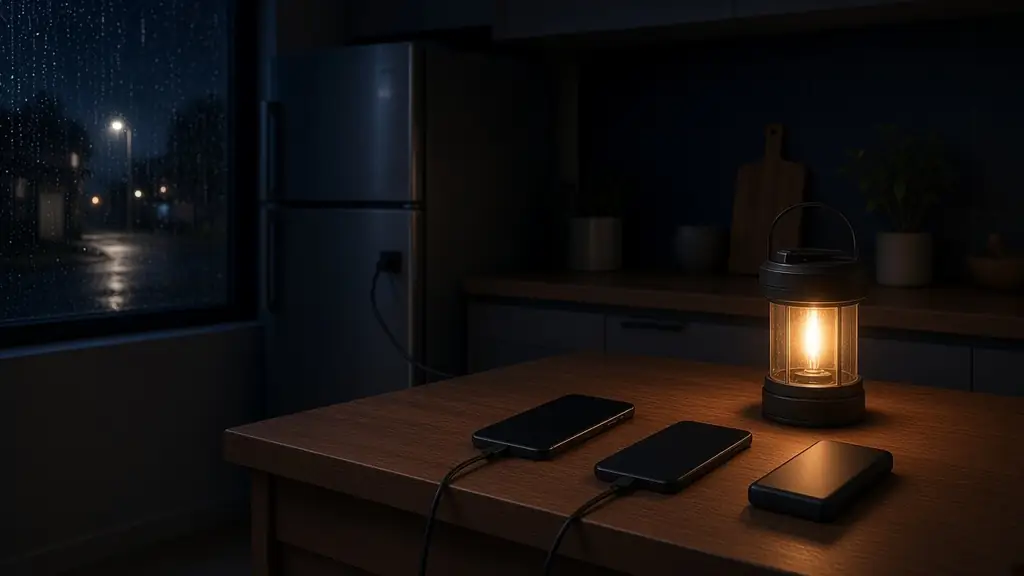
In a long outage, a charged phone is how you get weather alerts, talk to family and reach your utility. A little planning — the right battery, a way to refill it, and some low-power habits — will stretch that charge for days.
Power banks and the mAh-to-Wh math
Phone power banks are labeled in milliamp-hours (mAh). That number is not watt-hours, and it is not measured at the 5 V USB voltage. Lithium cells are rated at about 3.7 V, so:
Watt-hours ≈ (mAh × 3.7) ÷ 1,000
A bank labeled 20,000 mAh is about 74 watt-hours, not 100. After conversion losses on the way to 5 V, you might get around 50 to 60 Wh at the cable. A modern smartphone battery is often around 12 to 15 Wh, so that bank is roughly three to four full phone charges, not the "eight or ten charges" some listings imply.
If you want to run a laptop, a CPAP, or a Starlink Mini, look at watt-hours and at the USB-C PD output in watts, not only at mAh. The official Starlink Mini USB-C cable, for example, needs a 100 W, 20 V / 5 A source even though the dish itself averages much less.
A bank labeled 20,000 mAh is about 74 watt-hours, not 100.From this guide
Power stations
A portable power station is a larger battery with AC outlets, USB ports and usually a 12 V socket. It is the simpler choice if you also want to keep a router, a laptop or a few lights on. Size it the same way as in how to size a portable power station: add up watt-hours per day and divide by about 0.85. For phones and a router alone, even a small 200 to 500 Wh station lasts a long time.
Solar panels and solar charging
For an outage that lasts more than a day, a folding solar panel can refill a power station or a large bank. A 100 W panel in good midday sun might add very roughly 300 to 500 Wh on a clear day, and much less in winter, under clouds or if it is not aimed at the sun. Keep the face clean, tilt it toward the sun and do not count on it as your only plan for a multi-day storm.
Charging from a car, safely
A 12 V car outlet (the old cigarette-lighter socket) can charge phones through a USB-C car charger, or run a small inverter for a laptop. Do this only with the vehicle outdoors. Never idle a car in a closed garage, a partly open garage or a carport against the house. Exhaust is carbon monoxide; it can kill you in minutes. If you start the car to recharge a battery or a phone, do it in the open air, away from windows and doors, and do not sit in a closed cabin with the engine running for long periods.
A small 300 W pure sine car inverter is enough for phones, tablets and many laptops. It is not enough for a fridge or a furnace, and it will drain a car battery if you use it with the engine off. See how to run a gas furnace during a power outage before you try to push larger loads from a vehicle.
Low-power habits and what to prioritize
Charge the things that keep you safe and informed first: phones, a battery or crank radio, medical devices, then one light. Routers and a laptop come next if you need information or work. TVs, game consoles and extra tablets can wait.
- Turn the screen brightness down and use dark mode where it helps.
- Enable low-power or airplane mode when you do not need a connection; turn the radio back on to check messages.
- Close apps that use GPS, live video or background refresh.
- Charge one device at a time from the smallest battery that will do the job, and keep a second bank in reserve.
- Keep the fridge closed and use a lantern instead of overhead lights, so a power station is free for communications.
Runtime table
Figures below are rough, after typical conversion losses. Your devices will differ; treat this as a planning aid, not a guarantee.
| Source (usable energy, approx.) | Smartphones (13 Wh each) | Phones + Wi-Fi router (20 W) | Laptop (45 W) |
|---|---|---|---|
| 10,000 mAh bank (~37 Wh, about 28 Wh at USB) | about 2 charges | about 1 hour of router plus a phone top-off | less than 1 hour |
| 20,000 mAh bank (~74 Wh, about 55 Wh at USB) | about 4 charges | about 2 to 3 hours | about 1 hour |
| 24,000 mAh, 140 W PD bank (~89 Wh) | about 5 charges | about 3 to 4 hours | about 1.5 hours |
| 500 Wh power station (~425 Wh at AC) | many charges | about 20 hours | about 9 hours |
| 1,000 Wh power station (~850 Wh at AC) | many charges | about 40 hours | about 18 hours |
If you also need home internet from a satellite dish, see how to keep Starlink on during an outage. For a full household list, use the outage prep checklist and the sizing calculator.
Example charging gear
Power banks
- Anker 737 Power Bank (24,000 mAh, 140 W)24,000 mAh (~89 Wh); 140 W USB-C PD 3.1 output
- Anker 25,000 mAh laptop power bank (165 W)25,000 mAh; 165 W total output, up to 100 W per USB-C port
Power station and folding solar panel
- EcoFlow RIVER 3 (230 Wh) portable power station230 Wh LFP battery; about 1-hour AC recharge
- Anker SOLIX C1000 Gen 2 portable power station1,024 Wh; 2,000 W output (3,000 W peak)
- Anker SOLIX PS100 100 W bifacial portable solar panel100 W rated bifacial folding panel; about 7 lb with stand; IP68
12 V car charging, lantern and radio
- Anker 167.5 W 3-port USB-C car chargerOne USB-C port at 100 W, plus 45 W USB-C and 22.5 W USB-A
- BESTEK 300 W pure sine wave car inverter300 W continuous, 700 W peak, 12 V to 110 V AC pure sine; USB-C PD port
- Coleman Classic Rechargeable LED LanternUp to 800 lumens; built-in rechargeable battery with USB charging port
- Midland WR120B NOAA weather radioNOAA weather alerts with SAME; battery backup
Specs come from each product's Amazon listing (checked Nov 27, 2026). We don't list prices, so check the current price, stock and compatibility on Amazon. These are examples that fit the size, not the only good choices.
Published by Good Vision Media. Updated November 27, 2026. General information only; for anything wired into your home, use a licensed electrician.